01 / Local inference
Keep the complete pipeline on device
Bundled ONNX models run through OpenCV and ONNX Runtime on the CPU. Camera frames stay local, model files are verified before loading, and the application needs no API or runtime download.
Face Signal / local computer vision / native Windows
A local facial-pattern and meme-morphing prototype that translates seven visible expression categories and 66 facial landmarks into responsive image warps.
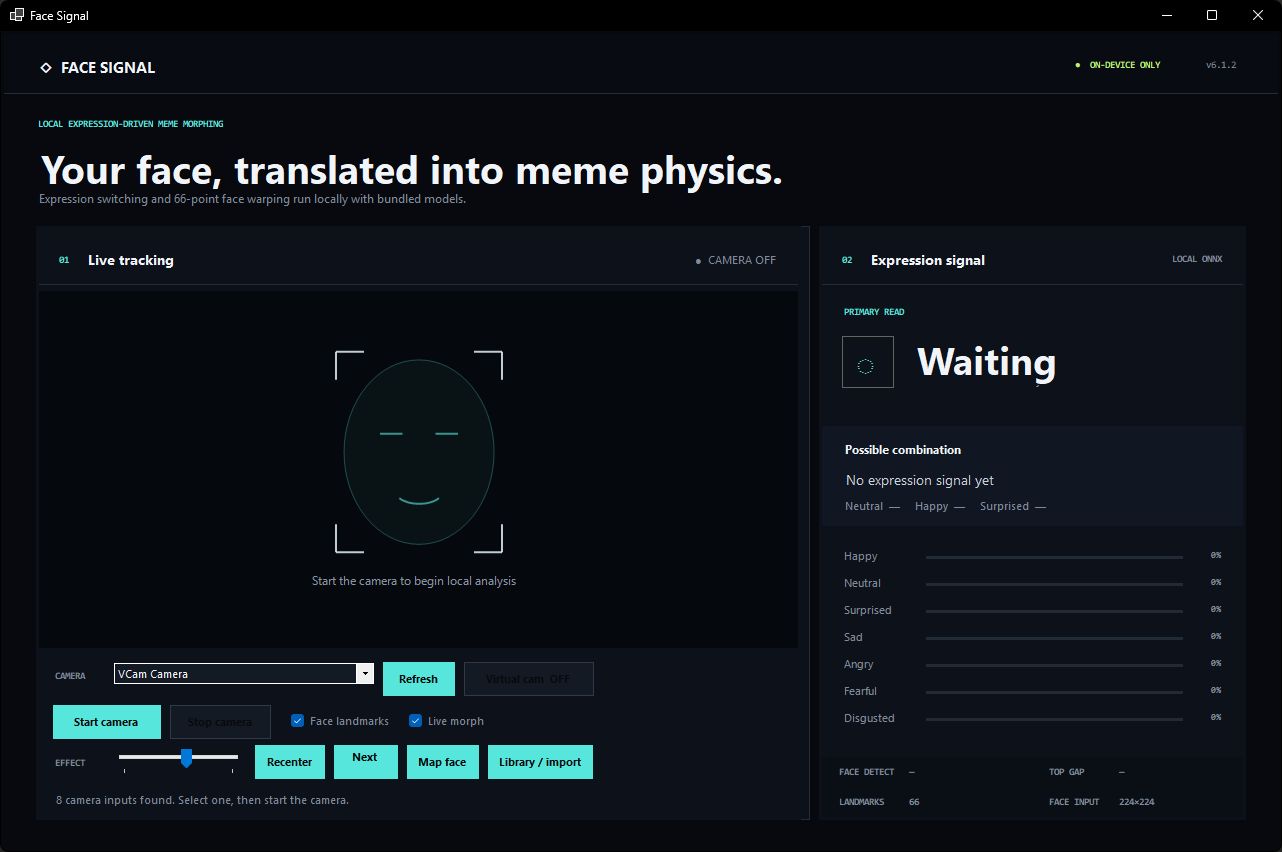
The complete pipeline runs on the computer. YuNet detects and aligns the face, a Progressive Teacher model reads seven expression classes, dense landmarks drive position and deformation, and LeFaceCam publishes a clean virtual-camera output.
Design problem
Expression models can feel opaque when a score appears without context. Face Signal keeps detection, alignment, category confidence, facial landmarks, media selection, and warp controls in one visible flow.
01 / Local inference
Bundled ONNX models run through OpenCV and ONNX Runtime on the CPU. Camera frames stay local, model files are verified before loading, and the application needs no API or runtime download.
02 / Stable switching
Confidence, score-gap, dwell-time, and cooldown checks prevent a meme from flickering between categories. Neutral clears the effect so the live camera remains the stable background.
03 / Hand mapping
The mapper exposes face bounds, brows, eyelids, mouth corners, lips, and jaw. Saved normalized anchors let each image deform from its own visual structure instead of relying on one generic crop.
Inference and output loop
The preview follows the camera's natural orientation, and the landmark coordinates use the same left-to-right frame.
Live software captures
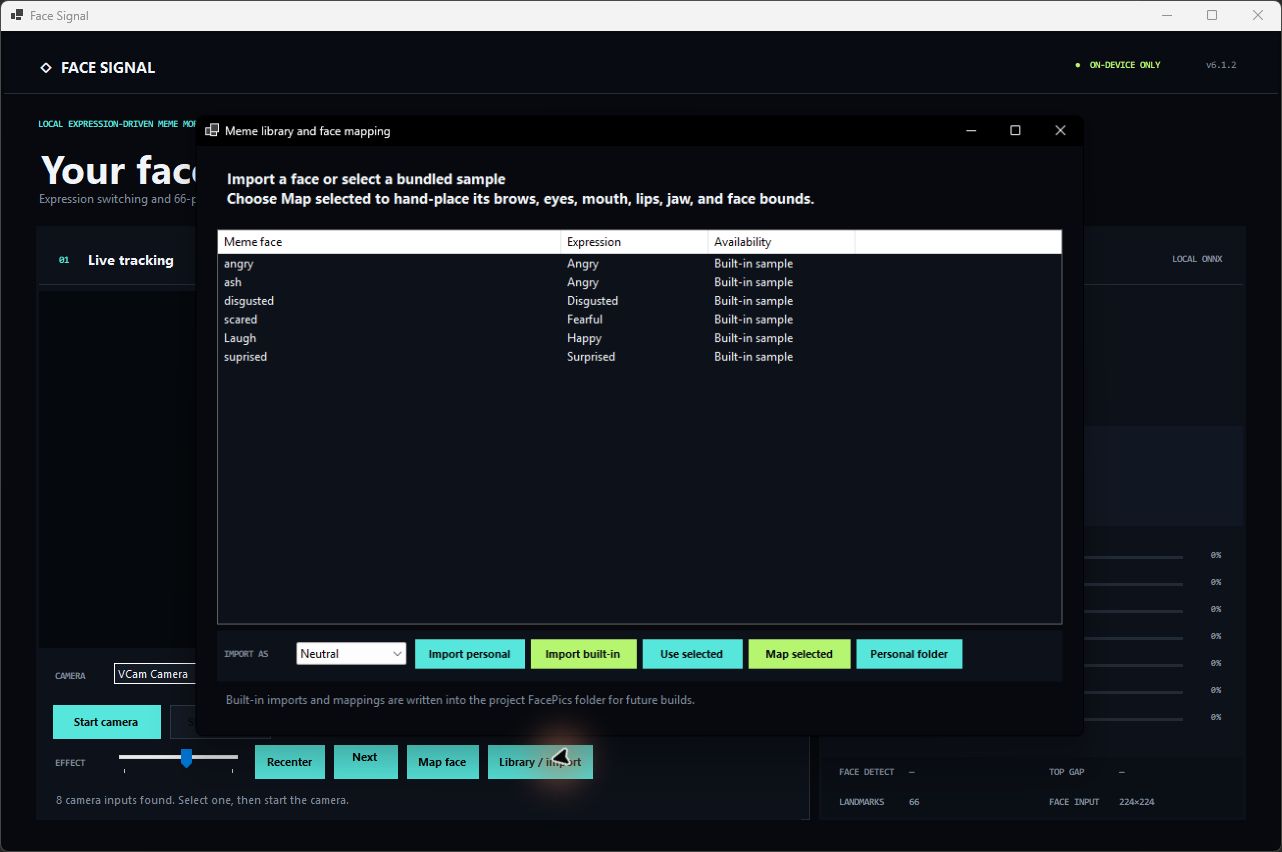
The main dashboard keeps the local signal readable. The companion library makes bundled samples, personal imports, expression assignment, and face mapping available without leaving the application.
Meme motion
04 / Spatial tracking
The saved source-face rectangle aligns the complete meme image to the tracked face, then bounded prediction and smoothing keep the result responsive without turning small tracking errors into violent jumps.
05 / Feature deformation
Brow, eyelid, lip, mouth, and jaw deltas deform the selected picture from its mapped neutral pose. An effect slider moves from restrained motion to deliberately excessive meme physics.
06 / Recoverable controls
The user can recenter a relaxed pose, choose the next meme, import a replacement, or reopen the mapper whenever tracking or source alignment needs correction.
Virtual camera
LeFaceCam uses Windows Media Foundation to publish the natural-orientation camera and active meme effect at 25 FPS. Face boxes, landmark dots, tracking lines, scores, controls, and status tags remain inside the Face Signal window.
The bundled media source exposes LeFaceCam as a Windows Virtual Camera on Windows 11 build 22000 or later. It uses a local app-owned memory-mapped transport and does not require OBS or a separate virtual-camera driver.
Technical boundary
The self-contained Windows x64 application bundles its .NET runtime, OpenCV native runtime, three ONNX models, sample images, mappings, hashes, and third-party notices. It uses no network request, cloud API, Python process, or local web server.
The seven scores classify visible facial patterns. They do not establish emotion, mental state, intent, identity, or truthfulness. Lighting, occlusion, pose, camera quality, and training-data differences can all change the read.
Public release / itch.io
The itch.io release for Face Signal is available under its public title, Clip Farm Assistant.